Phillip Buckhaults, a cancer genomics expert and professor at the University of South Carolina, testified before a South Carolina Senate Medical Affairs Ad-Hoc Committee, asserting that Pfizer's mRNA vaccine contains billions of tiny DNA fragments.
According to Buckhaults, there is a potential risk that these foreign DNA fragments could integrate into a person's genome, becoming a permanent part of the cell, and potentially leading to serious side effects, including cardiac arrest.
Despite his concerns, Buckhaults emphasized that he's not sounding an alarm and had reservations about publicizing his findings, fearing it might cause undue panic. He personally received Pfizer's COVID-19 vaccine three times and recommended it to his family and friends. He praised the mRNA platform technology as revolutionary and credited the vaccine with saving many lives.
However, Buckhaults expressed particular worry about the theoretical risk of future cancer in some individuals, depending on where the foreign DNA integrates into the genome. It could potentially disrupt tumor suppressor genes or activate oncogenes. He stressed that DNA is a long-lasting information storage system, which individuals inherit and pass on to their children, making alterations to it a lasting matter.
He attributed any contamination of the vaccine vials with DNA to the urgency of the crisis, suggesting that due to the rush, certain shortcuts were taken, which he believes were due to incompetence rather than malice.
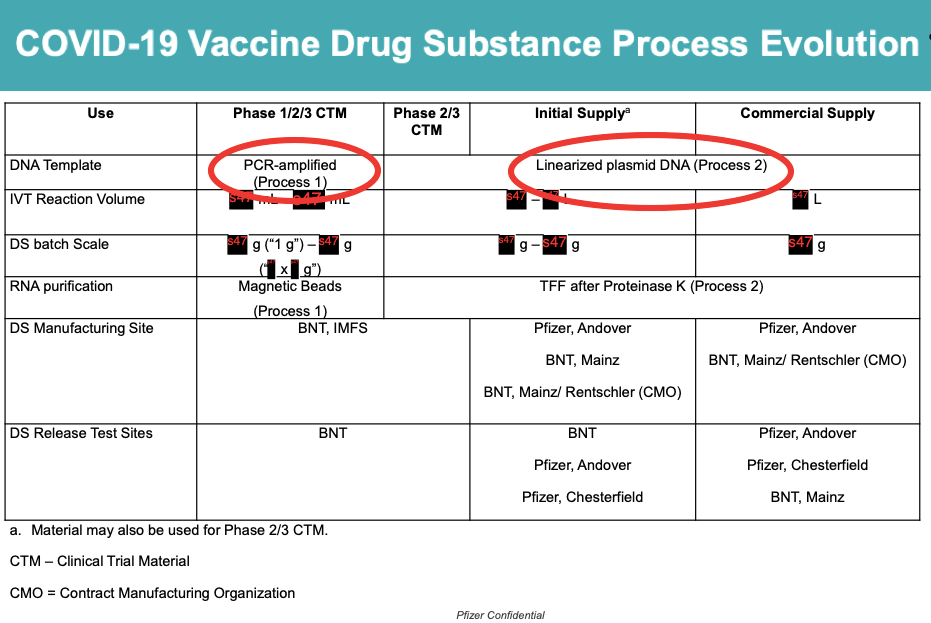
Buckhaults explained that Pfizer initially used Polymerase Chain Reaction (PCR) to amplify the DNA template for the mRNA production, resulting in a highly pure mRNA product (PROCESS 1).
However, for large-scale distribution, the manufacturing process switched to using bacteria to produce large quantities of “DNA plasmid” (circular DNA instructions) in addition to mRNA (PROCESS 2), leading to the final product containing both plasmid DNA and mRNA.
The switch from PROCESS 1 to PROCESS 2, ultimately resulted in the contamination of the vaccine (see red circles).
In an attempt to address the issue, Pfizer introduced an enzyme (DNAse) to break down the plasmid into numerous tiny fragments. However, Phillip Buckhaults contends that this exacerbated the problem. Having more fragments increases the likelihood of one of them integrating into the genome and disrupting a critical gene.
Buckhaults believes there was no malicious intent, rather a lack of foresight, describing it as an oversight. He suggests that adding an extra step to remove the fragments would have been a straightforward solution.
An investigation by BMJ revealed that vaccines originating from PROCESS 2 exhibited notably lower mRNA integrity, potentially leading to a higher incidence of adverse events.
Buckhaults' findings align with those of genomics expert Kevin McKernan, who also detected plasmid DNA contamination in both Pfizer and Moderna's bivalent COVID-19 vaccines, surpassing the safety limits set by the FDA.
https://youtu.be/IEWHhrHiiTY?si=fUVLpIIlBrLy5i7e
Read more at maryannedemasi.substack.com